
How to resolve AdBlock issue?
X
How to resolve AdBlock issue?
X

A high-protein diet during caloric restriction is an almost ubiquitous recommendation to maximize fat loss, muscle retention, and dietary adherence. Interestingly, one group of individuals in which this has not been well investigated is patients who have undergone bariatric surgery, which forces extreme caloric restriction. Only recently did Schollenberger et al publish findings from their pilot study investigating the efficacy of protein supplementation in a population that literally cannot stomach a lot of food.
Their randomized, placebo-controlled, double-blind examination was conducted at the University Hospital Tubingen, Germany, with 20 morbidly obese adults (17 female) allocated to either the protein (PRO) group that received protein supplements daily over six months after bariatric surgery or the control (CON) group that did not. Both groups received isocaloric powders similar in look, smell, and other characteristics, but the PRO group powder contained 88 g milk protein per 100 g powder while the CON group received pure maltodextrin. Patients of both groups were advised to take a dose of 15 g powder per day during the first postoperative month and 30-35 g powder per day for months 2-6.
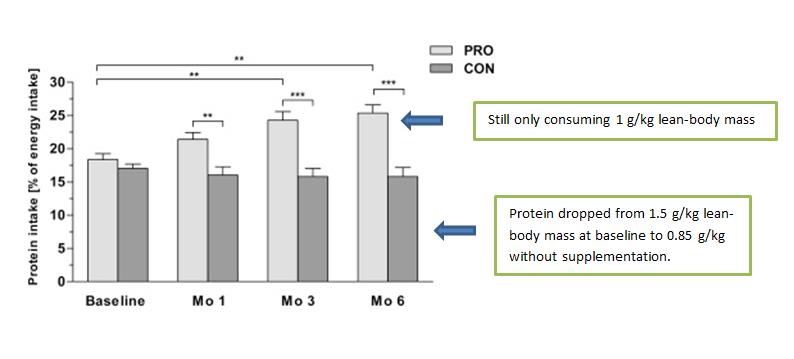
As an idea of how extreme post-surgery dieting is, total caloric intake was estimated at about 2200 kcal per day before surgery, which plummeted to 850, 1000, and 1200 kcal during the first, third, and sixth months, respectively. As could be expected, total protein intake was significantly higher in the PRO group compared to the CON group, but still only ranged from 36-66 g in PRO and 38-52 g in CON.
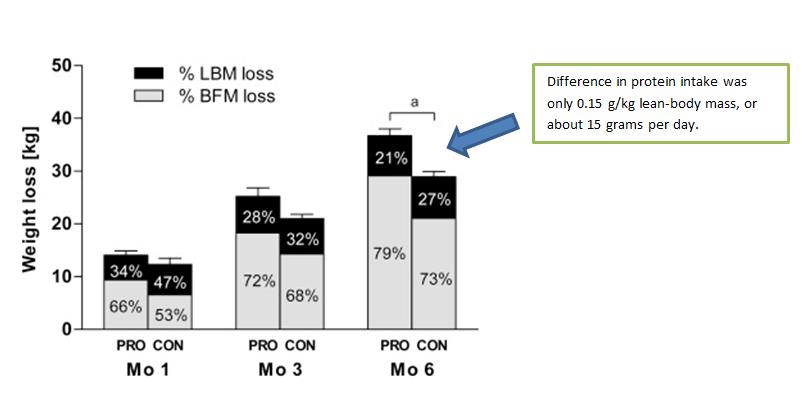
By the sixth month, body weight was reduced by 25.4% in the PRO group and by 20.9% in the CON group. The extra weight came primarily from fat mass, as lean body mass (LBM) decreased by about 11.5 % in both groups, but the fat mass was reduced by 37 % in the PRO group and 31 % in the CON group. Yet, none of these differences were statistically significant, perhaps because of the small sample size and resulting lack of statistical power. Nonetheless, when LBM and fat mass losses were expressed as a percentage of total weight loss, there was a significant advantage to the PRO group.
There were no differences between groups in nutritional indices such as iron status, but the total quality of life improved significantly in the PRO group only. Additionally, the number of participants reporting engaging in moderate-to-vigorous physical activity increased from zero at baseline to 14 out of 20 by six months.
This study doesn’t add much to what we already knew – higher protein diets result in greater fat loss and preservation of lean body mass when dieting, even when overall weight loss is similar. However, this study is unique in showing that protein supplements indeed improve body composition after bariatric surgery, which is a population with morbid obesity undergoing near starvation. Now, all we need is confirmation of these benefits in larger trials.
When you subscribe to the blog, we will send you an e-mail when there are new updates on the site so you wouldn't miss them.
Super Human Radio is the world's longest running broadcast dedicated to health, fitness & anti-aging with an emphasis on exercise, nutrition, and hormone management. This one of the most progressive podcasts for preventative & regenerative techniques designed to increase longevity. More
2908 Brownsboro Rd Ste 103
Louisville, Kentucky 40206
(502)-690-2200
Super Human Radio is the world's longest running broadcast dedicated to fitness, health, and anti-aging with emphasis on exercise, nutrition, and hormone management. The most progressive source of information for preventative & regenerative techniques... More
2908 Brownsboro Rd Ste 103
Louisville, Kentucky 40206
United States of America
+1 502-690-2200